Training Data, Simulation, and Digital Twins: How 2026 Humanoids Learn Your Tasks
How Robots Learn: From Human Demos to Digital Twins
Humanoid robots are becoming real workers and helpers. By 2026, companies like Tesla and Boston Dynamics expect robots that can assemble cars, fetch supplies, and even assist people. But how do these robots learn to do tasks? The answer lies in a training pipeline: humans first teach or demonstrate the task, the learning happens in simulations, and then engineers test everything thoroughly—often using a “digital twin” of the factory or home. In this article we explain each step in the journey: from recording human motion and remote teleoperation, through scripted routines and reinforcement learning in virtual worlds, to the final robot trials in the real world. We’ll also show how scanning a facility into a virtual model helps plan and test robot actions, and how engineers check that the new robot skills are safe and reliable.
Learning from People: Demonstrations and Teleoperation
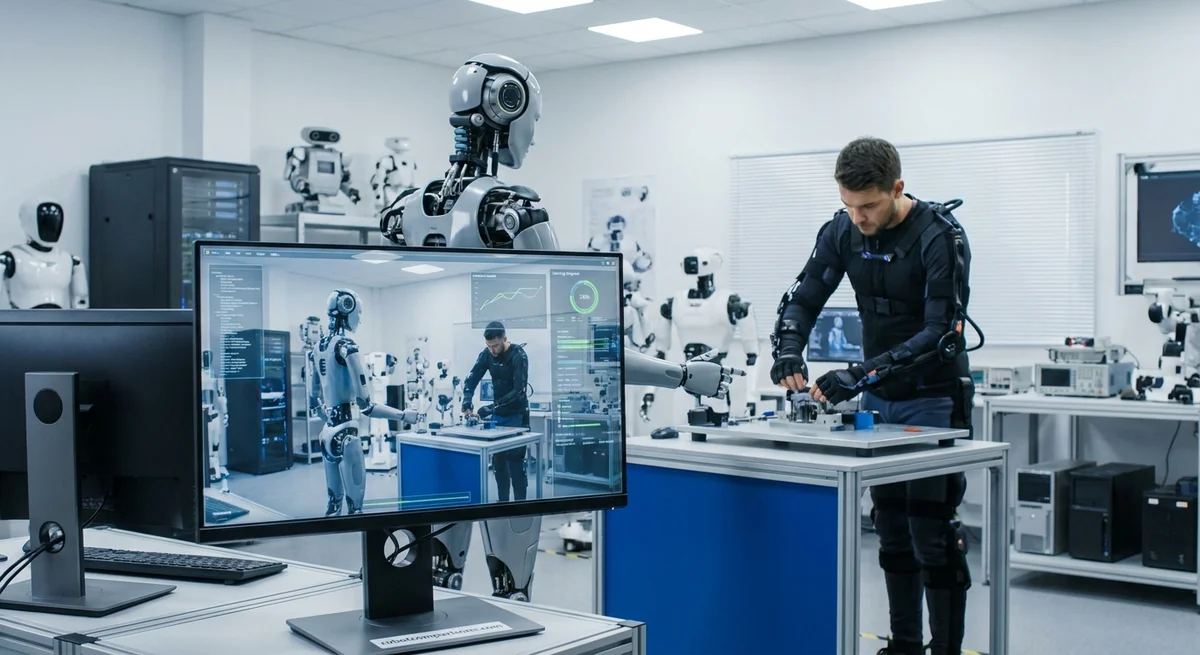
Robots often start by learning from humans. One common method is Learning from Demonstration (LfD). That means a person performs a task (say picking up a part or opening a door) and the robot records it as data. For example, engineers might use motion-capture suits or sensors to record exactly how a human moves a box. This clean human movement becomes “training data” that can be retargeted to the robot. A recent example from Boston Dynamics showed exactly this loop: capture human motion, map it onto the Atlas robot model, train the policy in simulation, then bring the skill back to the real robot (www.xsens.com). In short, “capture human motion, retarget it to the robot, train in simulation, deploy to hardware” is now a standard training recipe (www.xsens.com).
Another way to teach robots is teleoperation. In teleop, a human operator directly guides the robot (for instance with a joystick or VR controller) through the task. The robot records what happened. This is like a teacher holding a child’s hand to guide steps. For example, when Boston Dynamics recently demonstrated its Atlas robot at CES 2026, an engineer used a computer to pilot Atlas around the stage (apnews.com). The robot walked, waved, and even did a little dance under remote control. These demonstrations (both the exact robot motions and the visual feedback) become data that the robot’s AI can learn from. The same CES announcement mentioned that Atlas will eventually be autonomous on the factory floor, but for the public demo it was “remotely piloted” (apnews.com) to guarantee safety and control.
Example: A human might show a robot how to load a shelf by manually moving the robot’s arm in a VR setup. The robot watches or records joint angles during the teacher’s actions, then uses that as a blueprint.
From Scripts to AI: Programmed Policies and Robot Learning
Not every task needs complex learning. Many industrial tasks can be done by scripted policies – fixed instructions written by engineers. In this approach, experts program the steps precisely (“go to bin, pick part, move 1 meter to the left, place part”). These scripts work well if the environment is controlled and tasks don’t change much. For example, in a car factory an engineer might script a robot arm to pick the same engine cover out of a bin repeatedly.
However, for more varied or complex tasks, robots turn to Reinforcement Learning (RL) in simulation. Here, the robot’s control policy is learned by trial and error in a virtual world. The robot tries different actions because the simulation is safe and fast. Successful behaviors are kept, failures are discarded, and over many trials the robot “teaches itself” to do the task. Modern pipelines for humanoids often combine both worlds: a high-level scripted structure plus lower-level learned controllers. For example, engineers may write a basic walking script but allow a neural network (trained with RL) to adjust the exact balance and foot placement.
Large-scale robotics teams now use powerful simulators for this. NVIDIA, for instance, provides the Isaac Sim platform on its Omniverse engine. Agility Robotics (maker of the Digit robot) used this kind of tool to train a whole-body control model. In a published case, Agility ran billions of simulated steps to teach Digit how to stay stable if bumped or on uneven ground (www.nvidia.com). By running many trials in parallel on graphics cards, they shrank development time from weeks to days and then successfully deployed the trained models in real warehouses (www.nvidia.com). In other words, billions of virtual tries let the real robot learn safely.
Domain Randomization and Calibration
A big challenge is making sure what the robot learns in a game-like world transfers to the real world. This is called sim-to-real transfer. One key trick is domain randomization. This means the simulator deliberately varies things like colors, lighting, object shapes, and physics. For example, in one famous robotics study, the researchers randomized the texture, color, and position of objects in simulation so much that the real world just looked like another random case to the robot (axi.lims.ac.uk). In practice they taught a vision model to locate a real object by training only on fake images, and it worked with 1-2 cm accuracy (axi.lims.ac.uk). The idea is if the robot policy has seen a huge variety of simulated data, it won’t be thrown off by small differences in reality.
Besides randomizing visuals, engineers also calibrate the simulation to match the real robot. They measure the actual robot’s joint friction, motor speeds, weight distribution, sensor noise, etc., and tune the simulator accordingly. This way the learning is fine-tuned to the real machine. For instance, if the simulated robot is a bit “bouncier” than the real one, a foot grab in sim might not slip, so engineers adjust parameters until the virtual falls mimic real falls. When done carefully, calibration plus randomization make the sim-trained skills much more reliable in practice.
Virtual Twins: Scanning and Testing the Real World
Facility Scans and Digital Twins
Building on simulation, companies also create digital twins of entire environments. A digital twin is a virtual copy of a factory, warehouse, or home. To make one, the real space is scanned (using cameras or LIDAR sensors) and turned into a detailed 3D model. For example, Siemens offers a smartphone app that can scan an office with the phone’s LIDAR. The app stitches everything into a 3D map—with walls, doors, machines and furniture all in place—that can serve as a digital twin of the building (www.siemens.com). These twins are very precise; Siemens says its Metaroom system “captures real-world spaces in high detail, creating accurate 3D models that include walls, doors, windows, and furniture” (www.siemens.com).
Why make a digital twin? It means robots can be tested in a virtual replica before ever going live. If a warehouse floor is fully digitized, companies can drop the robot’s model into this twin and run simulations of everyday tasks. This helps check that the robot’s sensors and maps line up with reality. For instance, automated forklifts or delivery robots can plot routes in the twin to make sure they don’t get stuck. In one notable case, a pharmaceutical manufacturer built a digital twin of its 280,000 ft² cleanroom after an early deployment incident caused a $340K loss. By simulating all six mobile robots together in the virtual twin, engineers found collision problems early. After that, every software update was tested first in the twin. The result was zero real collisions for over a year, and deployment time for new robots shrank from 9 weeks of live testing down to just 6 days using the virtual twin (oxmaint.com). (This cutting-edge workflow was reported in 2026 by Oxmaint, a robotics software company, based on real factory experience (oxmaint.com).)
At universities and research labs, making scaled-down warehouse twins is also happening. For example, Carnegie Mellon researchers are developing tools to create digital twins of factory floors so that warehouse robots can “train themselves” to navigate new environments easily (engineering.cmu.edu). Their project is literally called “Digital Twins to Ready Warehouse Robots”, aiming to let robots assess and rehearse tasks in a virtual copy of the building (engineering.cmu.edu). This way, when the actual robots arrive on site, they already know the layout (the twin) and are less likely to act unpredictably.
Digital Twin for Planning and Diagnostic
Once a digital twin exists, it’s useful not just for path planning, but also for remote monitoring and maintenance. Imagine a robot or sensor inspecting a building and streaming data. That data can update the twin in real-time. For example, in Japan NTT Data ran trials where a tele-operated robot crawled along factory pipes. The robot’s cameras sent video to an AI that detected cracks in the pipes. The system then automatically marked these cracks inside the digital twin model (prtimes.jp). Maintenance engineers could log into the twin (from miles away) and see exactly where damage was detected, as if they were walking through the 3D model of the plant. Such remote diagnostics save time and keep people out of harm’s way.
Digital twins also aid testing of new robot software. Instead of testing on a busy shop floor, engineers plug software updates into the twin. The twin environment feeds simulated sensor data to the robot’s control system, letting developers catch issues without risk. In the pharma example above, the twin was used for re-validation after any change. As one whitepaper noted, after digital twinning all robots together, the factory achieved 14 months of zero collisions and validation time for new robots went from 9 weeks to 6 days (oxmaint.com).
Acceptance Testing: Verifying the Learned Skills
In robotics, you must prove that a newly learned behavior actually works and is safe before shipping it. This is called acceptance testing or system validation. The idea is to treat the robot policy like a finished product and verify it against specific criteria. Testing is not just eyeballing; engineers write precise pass/fail rules for each task. For example, a rule might be: “Success = the robot lifts the box off the shelf by 5 cm and places it within 3 cm of the target without dropping it” (claru.ai). Each task gets its own clear, measurable success condition.
Then the robot runs that task many times under slightly different conditions (different object positions, lighting, etc.) in the lab or a controlled setting. Each trial is recorded on a checklist: was it a success or failure? How long did it take? What exactly went wrong on failures? Robotics experts recommend doing this systematically. One guide suggests having multiple evaluators score trial videos to ensure agreement on what “success” means (claru.ai). This process catches ambiguity: if two people disagree on a trial’s outcome, the rules must be refined.
The goal is to build confidence. A structured testing framework confirms that the robot “performs its intended functions safely and reliably” (roboticsystemsauthority.com). Industry standards like ISO 9283 for robot manipulators also emphasize defined performance criteria and measurements. In practice, finishing an acceptance test may involve a mix of simulation checks, controlled physical trials, and safety assessments (like verifying emergency stops work). By the end, the learned policy should only be activated in the real world if the robot meets all the success criteria consistently.
Checklist example: Define exactly what counts as success for each step, write it down (for instance as binary yes/no tests), run the robot through 20–50 trials, and log the results. If any rule is unclear, revise it. Only when the robot passes all tests with high consistency does it “graduate” to real deployment.
Conclusion
Teaching humanoid robots new tasks is a multi-step process that blends human expertise, clever simulation tricks, and rigorous testing. People might start by demonstrating the task or even by teleoperating the robot. That data feeds into a simulator where AI learns by trial-and-error (often aided by randomizing the virtual world). Meanwhile, companies scan the real worksite into a digital twin so the robot can be tested there first. Finally, engineers run formal acceptance tests to make sure the robot truly does the job safely.
By 2026 this pipeline is already yielding results. Tesla is scaling up Optimus production (hoping those robots can one day water plants for the elderly, according to Musk (apnews.com)). Boston Dynamics’ Atlas has shown it can walk, wave, and even backflip, and it’s planned for factory assembly lines in 2028 (www.techradar.com). Agility Robotics is deploying fleets of Digits for warehouses and even announcing “robot armies” controlled from the cloud (www.axios.com). All of these companies rely on the same core ideas: data from demonstrations or code, simulation learning with domain variation, and virtual twins for testing.
For business owners and consumers alike, these advances mean we can soon see reliable humanoid robots handling routine tasks. And behind every smooth demo is a lot of careful engineering: capturing human knowledge, simulating trillions of steps, calibrating to reality, and double-checking with tests. That is how tomorrow’s humanoid helpers will learn your tasks — safely and smartly.
Never Miss a Robot Breakdown
Get deep research, head-to-head robot comparisons, and industry analysis delivered straight to your inbox — multiple times a week, completely free.