Reinforcement Learning
reinforcement learning
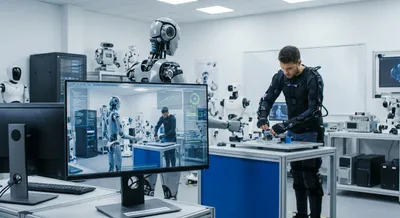
Training Data, Simulation, and Digital Twins: How 2026 Humanoids Learn Your Tasks
Robots often start by learning from humans. One common method is Learning from Demonstration (LfD). That means a person performs a task (say picking...
Reinforcement Learning
Reinforcement learning is a way computers learn by trying actions and seeing what works, much like training a pet with rewards and corrections. In this approach a learning agent interacts with an environment, chooses actions, observes what happens, and receives feedback in the form of rewards or penalties. Over many trials, the agent builds a strategy — called a policy — that aims to maximize cumulative reward, often by balancing exploration of new actions against exploitation of known good ones. Key ideas include states (what the agent perceives), actions (what it can do), rewards (what counts as success), and value estimates (predictions of future reward). Reinforcement learning handles problems where you cannot give direct answers for every situation, because the agent learns from the outcomes of sequences of decisions rather than labeled examples. It is widely used for teaching robots to move, for game-playing systems, and for any application that needs step-by-step decision making under uncertainty. The method matters because it can discover creative solutions that humans might not think of and can adapt to changing conditions. However, it can be slow to learn, needs lots of experience, and depends heavily on how rewards are defined. Careful design and safety checks are important when deploying these systems in the real world.
Never Miss a Robot Breakdown
Get deep research, head-to-head robot comparisons, and industry analysis delivered straight to your inbox — multiple times a week, completely free.